The Climate Finance Accelerator
The Climate Finance Accelerator South Africa (CFA-SA) is now accepting applications for the 2026 cohort. Preparing projects that are attractive to investors is challenging. Low-carbon projects are often perceived as higher risk because new technologies and business models are not widely understood. Regulatory and policy barriers can also create blockages in accessing capital at scale.
The Climate Finance Accelerator (CFA) is a global technical assistance programme funded by the UK government to directly support climate projects to access finance. The CFA partners with emerging economies to promote the flow of finance required to achieve their goal of limiting global warming to 1.5°C.
The CFA does not act as a transaction adviser or broker, nor does it raise capital on behalf of participants. Instead, by engaging with the CFA, businesses and project developers will receive tailored and fully independent advice that will help them align with investor requirements, prepare more compelling investment documentation, navigate policy and regulatory considerations, and build relationships that support outreach to potential financiers. The result is improved investor readiness, a clearer path to profitability and impact visibility, and a stronger foundation for meaningful investor engagement.
The CFA is a global technical assistance programme, funded by the UK Government which will:
- Work closely with in-country delivery partners. For South Africa the partners are NBI and Green Cape
- Continue operations in Colombia, Mexico, Pakistan, South Africa and Vietnam where significant investment successes have materialised
- Commence operations in five new countries: India, Indonesia, Kenya, Malaysia and Thailand
- Support these countries and partners to develop a sustainable pipeline of bankable, low-carbon projects
- Identify suitable financing options, working with financiers in-country
- Contribute to embedding a permanent CFA process in each country to identify financing for low-carbon projects to support countries’ efforts in implementing their NDCs
The CFA has 5 core aims:
- Strengthen the capacity of project developers to design low carbon, investable projects
- Establish networks between climate finance participants
- Improve participants’ understanding of climate finance
- Increase policymakers’ awareness of barriers and enablers in the enabling environment for climate finance
- Plan for CFA process is fully developed and owned by relevant stakeholders
There are 3 priority stakeholder groups for the CFA to engage:

Project developers

Finance community

Policy makers
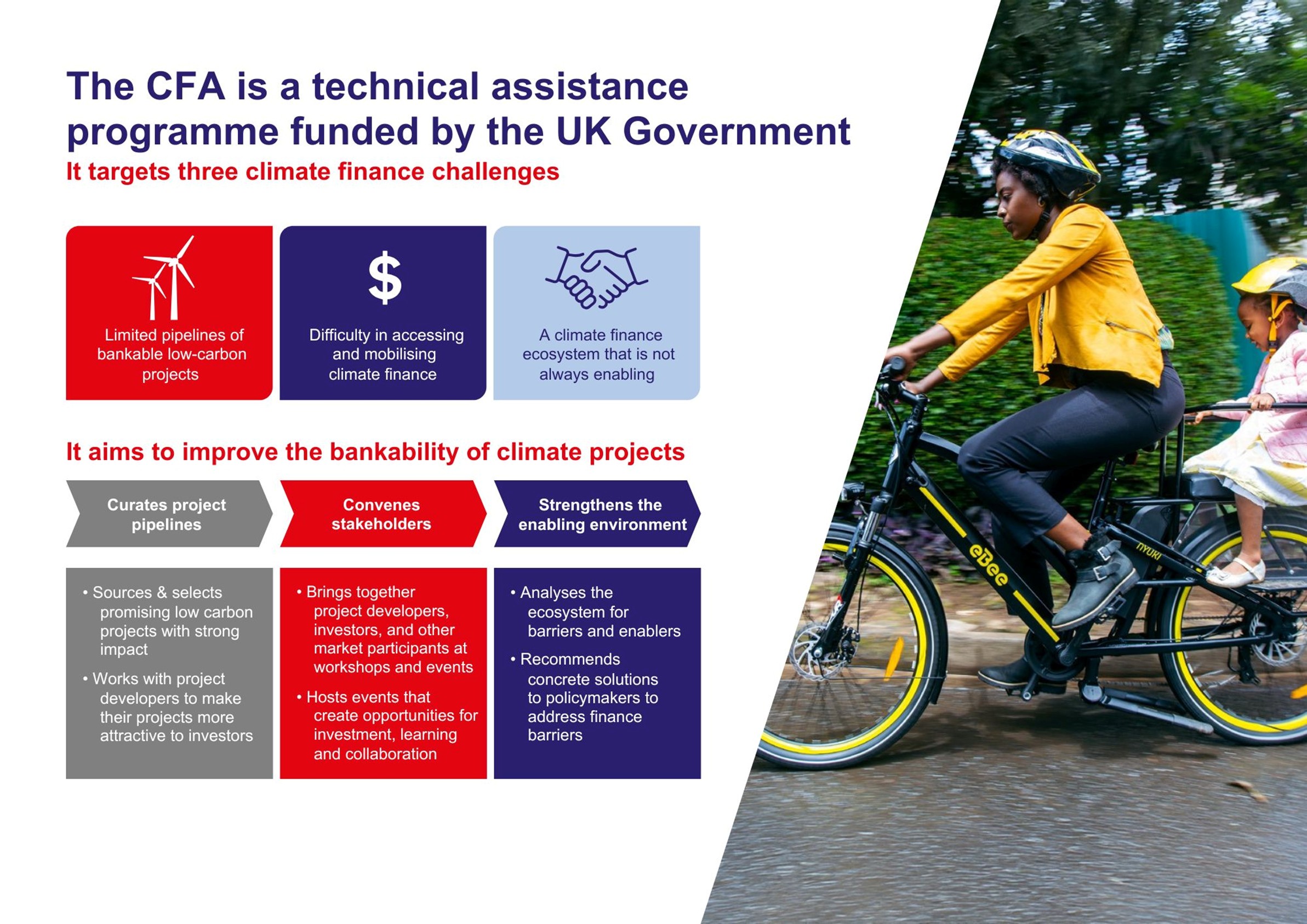
The CFA recognises key climate finance challenges and works to address the following:
- Insufficient pipeline of bankable projects – with the CFA offering support to project developers to make their projects more bankable.
- Climate projects struggling to access finance – with the CFA providing a convening function between project developers and financiers.
The CFA also recognises that there are enabling environment challenges that can be addressed through that convening power which includes policymakers, but the CFA offer focuses on providing recommendations on ways to address these barriers.
Through its hands on work with projects, the CFA identifies common barriers to finance that project developers face, and ways which the enabling environment could be improved to remove these barriers. Part of the CFA process involves making recommendations to policy makers to address barriers to finance.
The value/benefit of the CFA
 Tailored capacity building with financial, technical and gender equality, disability and social inclusion experts on a 1-2-1 basis
 Support with achieving low carbon objectives through webinars and technical capacity building
 Increase businesses visibility and provide access to investors and grant funders through engagements and at an in-country event – pitching to investors in an attempt to secure financial deals
 Support with access to national and international networks
 Address implementation barriers with policy makers
The CFA in South Africa
The CFA-SA is a practical and deal-oriented programme that supports climate projects to improve their bankability and appeal to financiers. In South Africa, the CFA brings together the key actors in the climate finance ‘supply chain’: project developers, finance providers (private and public, national, regional & global) policymakers and broader ecosystem players. The CFA also seeks to deliver several co-benefits, such as supporting a just transition through inclusive approaches to sustainable development, improved gender equality and social inclusion, and building resilience to climate impacts.
Before completing the application form, applicants should download and read the pdf which provides all the necessary guidance for your application, including questions asked and supporting documents required.
The 2026 CFA-SA call for proposals will be open from 10th December 2025 to 06th February 2026. Applicants interested in applying should be revenue-generating (for businesses) or at least at the post-feasibility stage (for projects), seeking a minimum of US$ 3 million in funding, with core technologies proven at a minimum of Technology Readiness Level 7 (System commissioning where full-scale Pilot/Product/Service is demonstrating performance for the operational environment), ensuring readiness for investment and scalability. We particularly welcome applications which demonstrate an impact in the energy, transport, waste management, water, or sustainable agriculture sectors.
10 December 2025 to 06 February 2026
The CFA-SA provides a package of support to project developers:
1. Project assessment
We will work to assess projects, establish how the CFA can be of most value, and then develop a tailored package of CFA support.
2. Capacity building
4-6 months of bespoke capacity building. Indicative content based on support provided to CFA applicants in previous cohorts includes:
- One-on-one sessions with financial, technical, and Gender Equality, Disability and Social Inclusion experts
- Tools & templates for project financing
- Webinars covering: Improving Financial Data Rooms and Pitch Decks; Understanding the South African Investor Landscape and Mandates; and Effective Communication and Branding for Your Business.
3. Multi-day event
We bring together projects and investors for a series of pitch opportunities, as well as shared learning sessions.
4. Ongoing relationship
We will agree on how the CFA can best support your project going forward.
The CFA in South Africa
The CFA launched the first Call for Proposals in 2021. In 2025 the Call for Proposals was launched on 10th December to identify ~10 high quality climate mitigation projects, strengthen their technical and commercial propositions, and connect them with suitable investors.
The CFA is looking for projects that:

Will achieve measurable climate outcomes

That have a minimum financial ask of US$ 3 million

Are at least at the post-feasibility stage

Will generate commercially viable returns in the long-term

Will have positive impacts on gender, inclusion and Just Transition
Applicants should be revenue-generating (for businesses) or at least at the post-feasibility stage (for projects), seeking a minimum of US$ 3 million in funding, with core technologies proven at a minimum of Technology Readiness Level 7, ensuring readiness for investment and scalability. We particularly welcome applications which demonstrate an impact in the energy, transport, waste management, water, or sustainable agriculture sectors.
Cohort of sectors/projects supported under the CFA South Africa





The Climate Finance Accelerator (CFA) South Africa
The Climate Finance Accelerator (CFA) is part of the UK Government’s investment into South Africa’s transition to a low carbon economy. For more than a decade, the UK has spent over £250 million in International Climate Finance support to SA.
CFA South Africa Phase 3: Early-Stage Cohort
The five projects selected in the early-stage pilot, for the CFA Phase 3 Cohort, had the opportunity to attend elements of the core capacity building training and were encouraged to share their experiences with members of the core cohort.
CFA South Africa Phase 3: Core Cohort
CFA Phase 3 Selected Cohort
Fifteen exciting climate projects from across the country were selected to take part in the third phase of the Climate Finance Accelerator (CFA) South Africa. The businesses were chosen from 173 applications following a rigorous selection process. The chosen projects came from the energy, transportation, agriculture, forestry and other land uses, circular economy and water sectors. For the first time two separate cohorts were created to trial providing capacity building to promising early-stage projects.
Cohort 1 Projects- 2021
- Black Soldier Flies Breeding South Africa – Providing black soldier fly larvae that can be grown by anybody and used to produce products such as protein meal, insect oil, biodiesel, and soil enhancer.
- Go-Lectric – Providing electric scooters to middle and low-income urban commuters as well as the growing short-distance delivery market. Also developing solar powered battery charging infrastructure.
- The Green Cab – Setting up a Cab Division where women owner-drivers will operate electric vehicles on a national e-hailing app under The Green Cab brand plugged into corporate services.
- Greenline Africa aims to revolutionize the way industrial processing produces their heat and steam by transitioning away from fossil fuels to a powerful renewable source – a dynamic solar thermal concentrator. This will reduce manufacturing costs and create sustainable jobs.
- MOTU – The installation of cloud-based metering and renewable energy equipment in new developments and retrofit buildings. Energy use is monitored in real time with artificial intelligence optimising the use of energy over time.
- RBN Fund Managers (PTY) Ltd and GFA Climate and Infrastructure (PTY) Ltd – New instruments to address funding climate infrastructure in Southern Africa by streamlining project financing into a single blended finance instrument through a partnership between commercial banks and institutional investors.
- Renewco – Cutting edge Biogas and other renewable energy solutions for small-medium scale operations, with a positive impact on the natural environment through waste stream management and recovery of water to use for irrigation.
- Restore Africa Funds – Promotes climate-smart conservation and regenerative agriculture at scale by supporting farmers to adapt to climate change while mitigating agriculture-based emissions and increasing soil carbon sequestration.
- SANERGY – Applies a circular economy approach to safe waste treatment and reuse, while addressing critical food security and environmental challenges in fast-growing cities. Sanergy’s Nairobi facility has the capacity to transform 72,000 t/yr of waste into insect-protein for animal feeds, organic fertilizers for horticulture, and biomass fuel for industry. Now scoping out expansion to South Africa.
- Spark Plaid Solar – A solar rooftop marketplace that manages and streamlines the fragmentation of solar installers, product suppliers and financiers to make solar simple for homeowners and businesses.
- Ukuqala Okusha – The first industrial Black-owned organic fertilizer company to enter the agricultural arena. Sewage is treated using black soldier flies, from which fertilizer protein oil and water are extracted. The profits from the fertilizer are then reinvested into the community.
- Wetility – Enabling clients to generate and store solar energy, automatically release the stored electricity to power homes and businesses, stay shielded from grid outages and save on energy costs.
Cohort 2 Projects-2023
- Alien Fuel Group – a solution to use biomass (derived from alien invasive tree species and wood waste) as a ‘green’ fuel. This fuel is used to supply heat and steam in industrial applications. The system provides cost-savings per ton of steam delivered and is easily retrofitted to existing fossil fuel boilers, using semi-gasification biomass burners, significantly reducing barriers to entry for potential customers.
- Blue North Sustainability – SHERPA is a cloud-based sustainability management system that supports agriculture and food businesses (from farmers to retailers) to develop, implement and report on sustainability strategies. It aids transparency, information exchange and trust building across complex supply chains, and utilizes holistic content frameworks tailored to different operational contexts – covering the economic, social and environmental dimensions of a business.
- CISR – The “grow a car” project is part of the recently established Natural Fibre Hub, a collaborative initiative between the CSIR and the Coega Development Corporation. A hemp-based industry is being developed in the Eastern Cape that will enable the formation of a full value chain, from farmers through to the development of high-value products for, amongst others, the local automotive industry.
- Flx EV – introducing electric minibus taxis to help decarbonise South Africa’s primary public transport mode. Electric minibus taxis will be supplied via a financing model that is affordable and scalable. Flx EV is also developing charging facilities in minibus taxis ranks to optimize vehicle performance.
- Green Riders (Pty) Ltd – disrupting the last-mile delivery market in Southern Africa by replacing petrol and diesel driven motorbikes with e-bikes and e-motorbikes that are environmentally friendly, cost-effective and custom-made for harsh African conditions. Green Riders aims to train 50,000 unemployed South African youths to become professional delivery riders in one of the largest sustainable job-creation projects ever. This will contribute to significant poverty reduction in township communities whilst reducing carbon emissions and pollution.
- The Good Company – The Good Company democratises smart food production by means of automated and distributed vertical urban farms, managed by communities in co-operative nodes across cities, towns and rural areas. This improves food security and inclusion, whilst reducing supply chain and environmental pressure.
- LiquidGold Africa – The City Scale nutrient and water plant will be the largest urine diversion and nutrient recovery project in the world. It will service and provide safe sanitation to over 600,000 residents in the informal sector of KwaZulu Natal. LiquidGold will produce over 1000 tons of high value fertilizer and 200 million litres of safe non-potable water per year leading to the biggest biological circular project in Africa.
- Mustapha Energy – Scaling up their flagship project in Athlone, they will use state of the art proven technology to convert industrial and municipal wastes into value furthering the circular economy. Phase 1 will manufacture a refuse derived fuel for coal offset. Phase 2 will use residual waste to produce energy through a thermal power plant process. By the end of 2024, up to 400 tons per day of municipal waste will be diverted from landfill and converted into fuel, electricity, heat, recyclables and secondary materials for the construction industry.
- NutrientLoop Corp – NutrientLoop is a cost innovator in the fast-growing market of insect protein for the animal feed market. The company has developed growing technology enabling it to dramatically reduce the cost of production for top-quality outputs at scale. This accelerates commercial adoption of black soldier fly larvae as a sustainable, socially responsible, and environmentally friendly alternative to fish and animal protein.
- Nutri Humus – Nutri Humus diverts organic waste from landfill and converts it into high quality inputs for Agriculture and Horticulture. Nutri Humus manufactures high-quality compost products that are rich in humus (decomposed plant and animal matter). Humus is an important component of healthy soils and the products manufactured by Nutri Humus contain nutrients and beneficial organisms that build healthy soils and support healthy plant growth.
- Plentify – enables cleaner, cheaper and more reliable energy. This is done this via HotBot, an award-winning load management platform that connects home appliances into virtual power plants to intelligently shift demand away from peak times and towards times when renewable energy is available, saving users and utilities money.
- SAMANJALO – Based in Mpumalanga, home to 70% of South Africa’s coal fired power stations, this project recycles coal waste to produce environmentally green products. Flyash will be mixed with technologically developed green cementitious materials to produce products such as bricks, pavers and products for precast concrete applications and masonry. This process reduces carbon emissions by up to 80% because it does not require high temperature treatment.
- SeaH4 (Pty) Ltd – Pioneering a consumer ready carbon neutral alternative to fossil fuels, SeaH4 uses algae to catalyse ocean-dissolved CO2 and the energy of the African sun into biofuel at scale. It uses established technologies and the fuel produced is compatible with the existing transport infrastructure and requires no changes to engines making it ideally suited to decarbonise the transport sector. It also improves ocean health and brings economic opportunities to rural coastal communities. The solution applies to 20,000 kilometers of desert shores, 13,000 of which are around Africa.
- Solar Turtle SA (Pty) Ltd – a socially oriented business that has been developing solar solutions to assist with job creation in informal communities since 2016. The Green Tower Energy Security as a Service includes solar PV electricity with battery back-up sold on a pay-as-you-go basis to residential communities. Partnering with existing bulk metering providers that serve thousands of housing complexes across South Africa will enable the sale of Green Tower solar electricity generated at competitive rates to homeowners on a large scale.
- Westore – Building Africa’s first energy storage leasing platform. The platform will allow anyone to buy energy storage capacity assets through a cryptocurrency crowd sale. They can then use this to generate income from the storage asset that is contracted long-term to commercial customers. This aims to break the high-cost barrier for energy storage systems and accelerate the use of solar plus storage systems through hybrid battery and thermal storage technologies.
Cohort 3 Projects-2023
The ten core cohort projects are:
- Charge – catalysing the decarbonisation of the transport sector by installing 120 off-grid, green-powered, ultra-fast charging stations for passenger and light delivery vehicles. Located approximately 150 km apart, this first phase of installations covers South Africa’s major highways and regional routes (18,200 km).
- Creslow Energy Solutions – renewable battery manufacturer based in Mpumalanga. The energy storage solution is aimed at leisure, commercial and industrial markets (battery packs are suitable for small to medium factories and shopping malls), as well with specialised solutions provided for the mining sector.
- Cultura Fresh – expanding the existing successful hydroponic vegetable business to meet persistent excess demand. Cultura Fresh is currently the largest supplier of leafy greens in Western Cape. This expansion will create jobs and boost food security.
- EWaste Africa – expanding EWaste Africa’s existing offer of storing, collecting, transporting and end-of-life management of e-waste by diversifying into reuse, refurbishment and repair of e-waste (electrical, electronic, solar and lighting equipment waste) and increasing recycling facilities for hazardous e-waste.
- Loowatt – providing high-quality ‘Kalula’ home toilets to customers in urban neighbourhoods that lack adequate sanitation access.
- Manganese Metal Company – constructing a 5000 ton per annum manganese sulphate monohydrate (MSM) plant, to be located in Mbombela. MSM is a key ingredient in electric vehicles batteries.
- MycoSure – addressing sustainable food production by developing mycelium-based submerged biomass fermentation technology to produce alternative protein and nutraceutical ingredients at scale.
- Nambu – turning food ‘waste’ into high value insect protein for livestock and pet feed – including dog kibble, liquid based feed additive and a basic ruminant feed – as well as pelletized frass (fertilizer),
- SOCO CAPITAL – a spin off from an Engineering Procurement and Construction company, now an Independent Power Producer delivering comprehensive solutions, including fully funded solar PV (Power Purchase Agreement) and battery offerings available for rental.
- Valternative Energy – bringing next-generation clean energy solutions to the e-mobility sector in South Africa with electric bikes, smart batteries and swap stations.
The five early stage cohort projects are:
- Aquagel – Regenr8 is addressing climate change through food security. Regenr8 does this by offering organic biostimulant that disrupts the chemical fertilizer industry and stores CO2 in the soil for hundreds of years.
- Breev – Breev has a vision of an EV charger in every town in Africa and currently aims to expand EV charging along 980,000 km of roads in South Africa and Kenya, doubling mobility options and reducing environmental impact.
- React – enhancing access to recycling services and ethical standards by setting up decentralized micro material recovery facilities in low-income areas, integrating informal waste reclaimers as operators, and providing them with access to recyclables and eco-friendly transportation.
- Smartfill – connected smart dispensers enabling consumers to accurately fill any container with the quantity of dry food they need, eliminating plastic packaging.
- Solarfi – is set to connect 5 million individuals by distributing more than 500,000 innovative lantern-routers, delivering both internet and lighting to off-grid communities and driving progress through sustainable technology.

Media Releases:

South African Projects Seize OpportunityTo Tackle Climate Crisis And Create Jobs

UK Government Supports Climate Projects In South Africa

British High Commission together with the NBI and GreenCape launch Climate Finance Accelerator in South Africa and open call for proposals.
Climate Finance Accelerator South Africa: First Cohort of Projects Announced
What groups are involved in the CFA?
The CFA Team in SA
The global programme is delivered by PwC. The National Business Initiative (NBI) in partnership with GreenCape have been appointed as the national delivery partners for the CFA South Africa.
Delivery Partners

Core Team

UK Government
