
Why do we need to Skill for the Just Transition?
With the Integrated Resource Plan (IRP 2025) stipulating a target build of 105 GW in new capacity through 2039, including 59 GW in solar and wind power, South Africa will experience a significant energy transition.
To ensure that this transition is Just and inclusive, a concerted effort must be made to prepare the workforce for new employment opportunities that will be catalysed through the energy transition, while addressing potential job losses and economic exclusion. Many of the new opportunities will require skills that are currently lacking in the country. Given the high unemployment rates in SA, the risk of vulnerable groups being further marginalised due to being ill-equipped for emerging opportunities is also high.
What is the Just Energy Transition Skilling for Employment Programme (JET SEP)?
It is critical to develop a national, Just and inclusive skilling ecosystem in South Africa that supports the Just Transition, identifies opportunities and mitigates job losses.
JET SEP coordinates private sector efforts to accelerate the preparation of the workforce in support of the government’s JET Skilling Implementation Plan.
Objective: Contribute to developing a skilled workforce by coordinating the private sector’s approach to demand-led skilling for emerging jobs on the pathway to a Just Energy Transition.
JET SEP Reports

Building an Inclusive and Responsive Skills Ecosystem for a Just Energy Transition
This publication identifies the structural challenges that constrain system responsiveness to the skills demands of the Just Energy Transition, highlights areas where coordination needs to improve, and sets out practical interventions to strengthen planning, funding, provision and workplace-based learning.
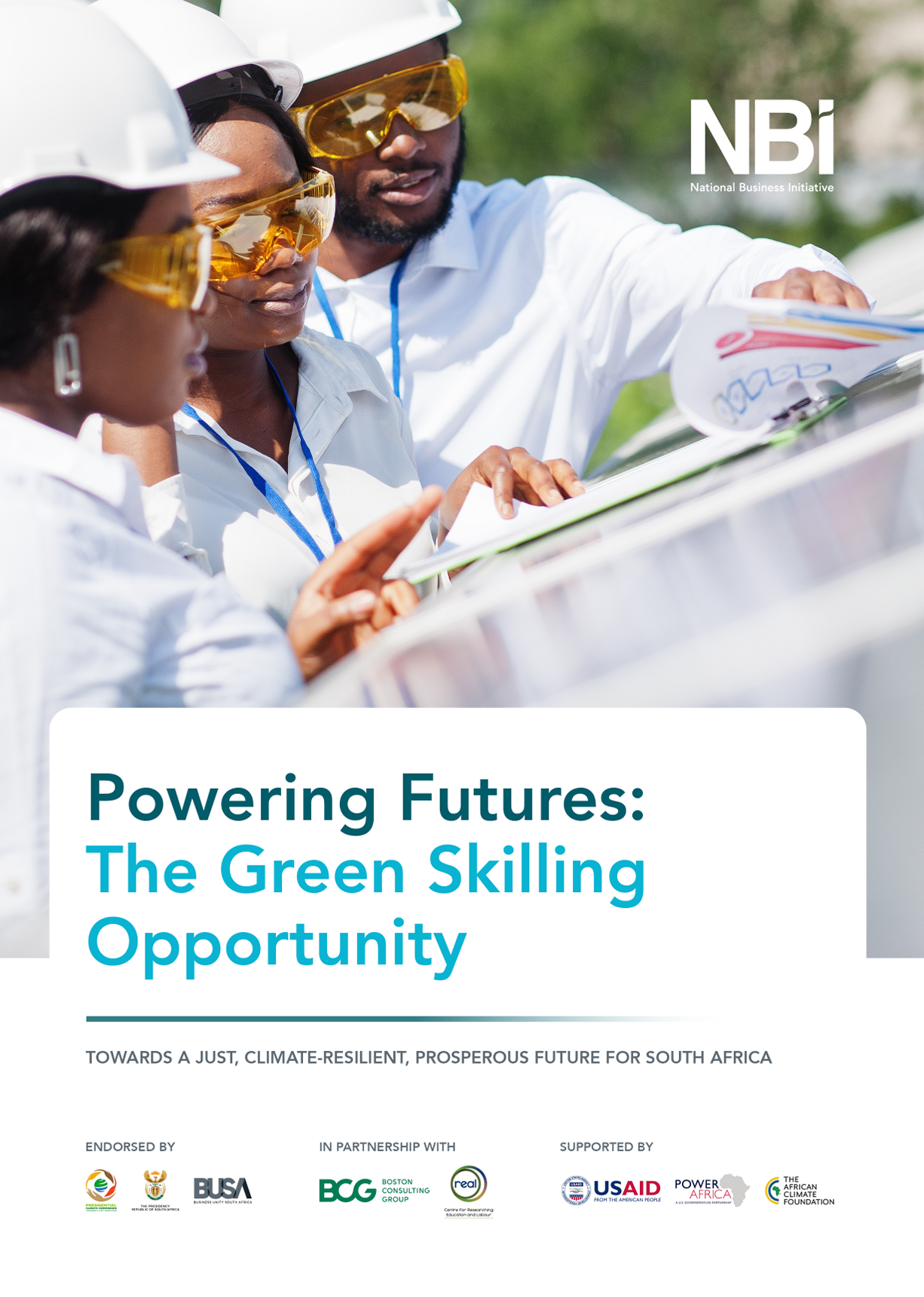
Powering Futures: The Green Skilling Opportunity
This publication consolidates data estimating future demand for jobs and skills across green technologies, value chain and occupations, providing critical insight to help align workforce development efforts with the needs of the economy. In doing so, it offers an important foundation for action, moving us towards practical and targeted solutions.
Factsheets

Just Energy Transition Skilling for Employment Programme

Empowering SMMEs and Unlock More Opportunities for Market Entry

Facilitation of Energy Efficiency Candidacy Placement

Nation-wide Renewable Energy In-service Training Programme

Transmission Talent Acceleration Initiative
Role of the Private Sector
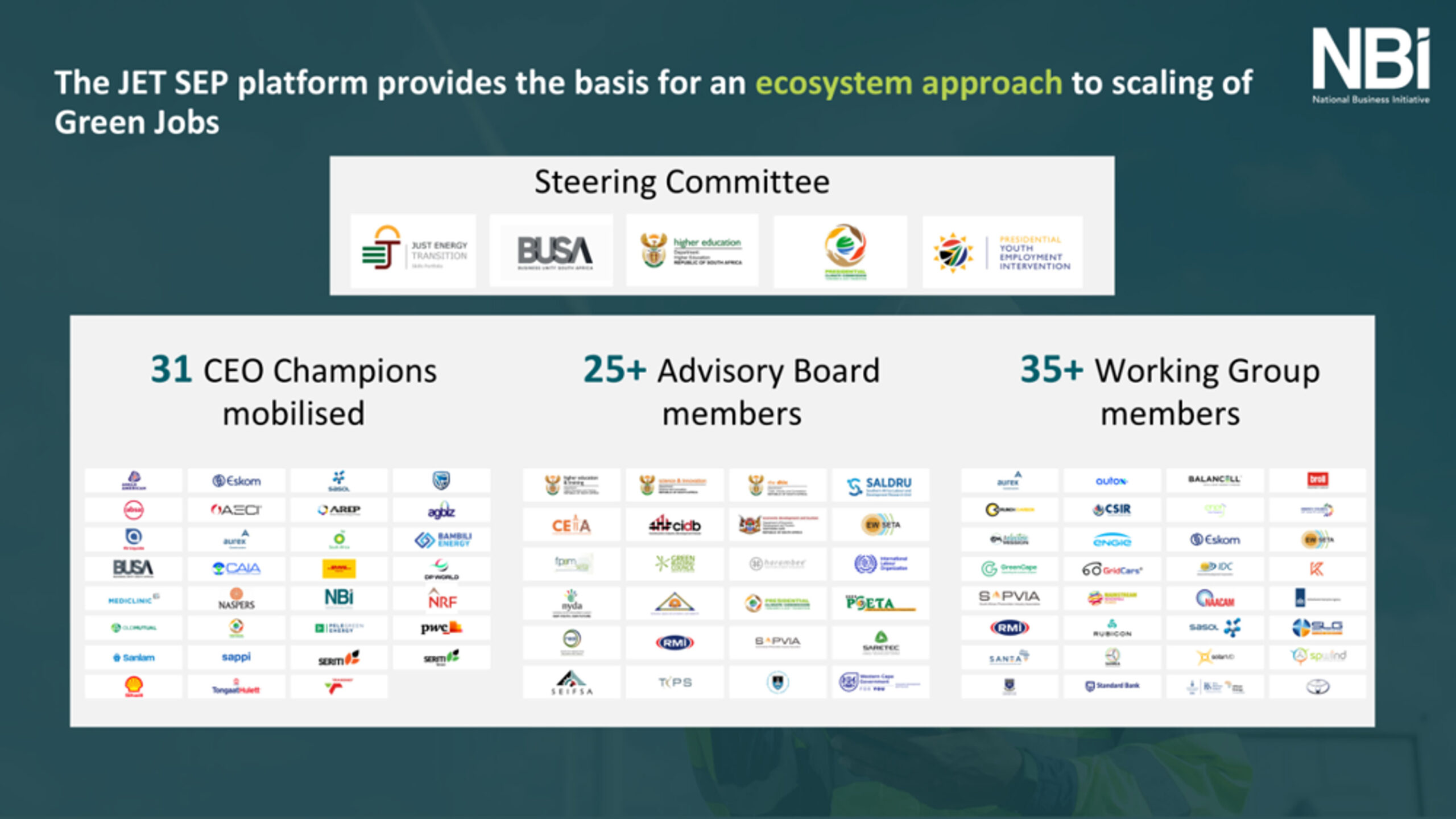
Since the launch of the JET SEP in April 2024 significant progress has been made in engaging the private sector to support the Skills Chapter of the JET Implementation Plan (JET IP). Through our CEO Champions Board, we have collaborated with 31 of the country’s leading CEOs and over 50 business, government, NGO, and academic stakeholders. JETSEP is endorsed by the Presidency’s JET Project Management Unit (JET PMU), Business Unity South Africa (BUSA), and the Presidential Climate Commission (PCC), and works closely with the JET Skills Desk within the Department of Higher Education and Training (DHET). This effort underscores the importance of a coordinated approach to skilling South Africa’s workforce for the transition.

This work builds on earlier efforts by the National Business Initiative (NBI), in partnership with Business Unity South Africa (BUSA) and the Boston Consulting Group (BCG), to develop potential decarbonisation pathways for the South African economy together with private sector stakeholders and broader representatives from government, labour and civil society. This body of work has shown that it is possible to achieve a net zero emissions economy by 2050, provided action is accelerated and sustained.
JET SEP is guided by these five interventions identified in the JET Implementation Plan
JET skills ecosystem and skills forum focusing on a coordinated approach to skills anticipation, development, and utilisation.
JET Skills Development Zones (SDZs) focused on three core value chains focused on applied skills anticipation, development, and utilisation for the three value chains – Electric Vehicles, Green Hydrogen, RE and Transmission.
JET skills development needs assessments for the three core value chains.
Providing support to existing, growth oriented IRM SMEs/entrepreneurs to increase enterprise capacity, technical skills, and market access, on the proviso that they train and employ youth.
Foundational skills development support to teachers and educators.
JET SEP governance incorporates a breadth of stakeholders and is key to ensuring robust and nuanced recommendations:
The CEO Champions Board provides directional input on content at key milestones. 31 CEO Champions currently amplify the work and engage with other leaders to support the demand-led skilling approach.
The Steering Committee, made up of the Presidential Management Unit (JET PMU), Business Unity South Africa (BUSA), Presidential Climate Commission (PCC), and the Presidential Youth Employment Initiative (PYEI), FirstRand Empowerment Foundation (FREF) and Lead CEO Champions, is the decision-making authority on key issues of content developed. Their ultimate role is to guide the synthesis of the overall recommendations to JET Skills Desk.
The Advisory Board has a broad set of stakeholders including representatives from academia, industry councils, labour and skilling associations. This board provides commentary on key technical and methodological topics to enable high quality outcomes for the JET SEP.
Central to the ongoing discussions are the Working Groups. These groups provide foundational input to content development and support subsequent implementation. Solar, Transmission, Green Hydrogen, Energy Efficiency, Wind, Battery Energy Storage Solutions (BESS) and New Electric Vehicles are the critical sectors guided by the JET IP Skills Chapters.
With phase one completed, the programme delivered the following outcomes:
Mobilised private sector companies in support of demand led skilling and the PMU led JET Skills Implementation Plan.
Developed a publicly available skills and jobs gap fact base
Provided ecosystem recommendations to the PMU on the JET skills ecosystem and Skills Development Zone (SDZ) design.
Established a pipeline of projects and interventions to address forecasted skills gaps, forming the basis of phase two.
Phase two marks a transition from planning to implementation, with a strong emphasis on mobilising partners to deliver targeted interventions. By coordinating collective action across stakeholders, JET SEP seeks to translate strategic priorities into tangible workforce development outcomes that support South Africa’s Just Energy Transition.
Explore the JET Atlas
Explore the JET Atlas, a JET Jobs Forecasting dashboard that helps you explore renewable energy job opportunities across South Africa. The tool provides insights to support understanding of the jobs potential associated with the country’s Just Energy Transition.

In partnership with



Funded and supported by


